Saturday, May 7, 2016

Week 6 - Bio Tech + Art

Moet's impressionist depiction
of a Church
The question that seems to be underlying this week's learning is: how does one define art, and how far does that definition extend. It seems to me that throughout history, the evolution of Art is always met with a very strong initial opposition. Artists like Claude Monet or Vincent Van Gogh, were seen as outcasts as they moved the concept of art beyond realistic portraits and detailed paintings of events, into a more abstract impressionist realm of emotion and feeling. However; society ultimately saw the value in such forward thought. The same goes for Marcel Duchamp's rejection from the world of art after he submitted a urinal to the exhibition for the Society of Independent Artists in 1917 and called it Fountain. A few years later though, everyone realized his genius in expanding the concept of art itself as is written in The Blind Man, a New York Journal, "He took an ordinary article of life, placed it so that its useful significance disappeared under the title and point of view - created a new thought for that object" (1917). The reason I bring this up is because similar push back on progressively artistic thought is being given towards BioArt. A great example is Marta de Menezes' Nature? where she genetically modifies the patterns of a butterflies' wings. This became incredibly controversial after holes formed in their wings, saying that this isn't art. But I would argue the contrary and say that it absolutely is, because the medium for art is becoming less and less defined as people continually push its boundaries. Professor Vesna states in her lecture, "As technology and biotechnology advance, the palette of artists expands" (Vesna, 2016).
Fish and Chips
Another great example of art's pallets expansion was performed by SymbioticA. Entitled, Fish and Chips and later renamed MEART a robotic arm was electronically stimulated by the firings of goldfish neurons. This was created to explore a concept called the "Semi-Living Artist" with a very simplistic medium of basically paper and some pencils, but produce the image by completely unique means. Art is constantly being criticized and marginalized in the public eye because people simply do not understand its complexities. This is no reason to declare it, "not art."
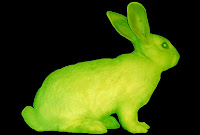
Alba
Art is an experience, and if Eduardo Katz wants to make a bunny glow yellow with the fluorescent genes of a jellyfish and call it Alba, go ahead. It doesn't need to be a painting or traditional sculpture. A reaction to the work is enough to declare it art, and ultimately as long as laws aren't being broken, I do not believe that there should be any restrictions on human creativity or the definition of art; however, there always will be because ignorance will never fade.


Sources


 De Menezes, Marta. "Nature?" Marta De Menezes. Web. 07 May 2016. <http://martademenezes.com/portfolio/projects/>.

The Blind Man, Vol. 2, 1917, p. 5

Victoria, Vesna, narr. "BioTech Art Lectures I-V." N.p. web. 7 May 2016.

 "MEART." MEART. SymbioticA. Web. 07 May 2016. <http://www.fishandchips.uwa.edu.au/>. 

"Transgenic Bunny by Eduardo Kac." Transgenic Bunny by Eduardo Kac. Genome News Network, 29 Mar. 2002. Web. 07 May 2016 <http://www.genomenewsnetwork.org/articles/03_02/bunny_art.shtml>. 


Images

https://upload.wikimedia.org/wikipedia/commons/3/30/RouenCathedral_Monet_1894.jpg


https://www.conncoll.edu/ccacad/zimmer/GFP-ww/images/alba2.jpg

http://www.frogheart.ca/wp-content/uploads/2012/04/Fish-and-Chips_ArsElectronica2001.jpg


Tuesday, May 3, 2016

Event 1 - In Focus: Electric!


On April 28th, I attended the special exhibit In Focus, Electric; an exhibition at the Getty Museum that references both the positive and negative effects of electricity" (Harris, 2106). The exhibit highlighted different aspects of influence that electricity has had over us humans, and it spans from early technological fascination to recent issues of our dependencies upon it. Consisting of mainly photographs, each one took an interesting view on the double edged sword that technology has become. Danwen Xing took a very interesting photograph that was on display, but originally part of his disCONNEXION exhibit (Xing, 2005) which consisted a bunch of used, old chords that are, "calling attention to industrial reuse or 'e-waste' that is dumped in China, a hazard to public health and the environment" (Sivak, 2016).
disCONNEXION
KuniƩ Sugiura also had a very bold photo of a lady who's figure was entirely illuminated by yellow christmas lights. This photograph, After Electric Dress A Positive 4 relates a very significant amount to our Robotics and Art unit when I discussed in my blog about our distrust of technology because of our attachment and reliance upon it. As illustrated in Alex Proyas' film I, Robot (2004), the main character, Will Smith, grows a genuine hatred for these robots that the futuristic society he lives in, has granted so much trust.
Electric Dress a Positive 4
This ties in to KuniƩ Sugiura's photograph as she exemplifies how electricity has taken over our lives and well being. Could you imagine going about a day of your life without electricity? It seems practically impossible. This special exhibit is relevant to our class teachings because the exhibit portrays the entire timeline of electricity's relationship with humanity and art as it begins with a genuine fascination and exploration to its evolution into an integral part of society with an unfortunate dark side of pollution and dependence. This was a phenomenal exhibit that I really did enjoy going to very much.


Sources

 "News from the Getty | J. Paul Getty Museum Presents In Focus: Electric!" The Getty. 14 Mar. 2016. Web. 03 May 2016. <http://news.getty.edu/press-materials/press-releases/getty-museum-exhibition-electric.htm>.

 "DisCONNEXION." DisCONNEXION. Web. 03 May 2016. <http://www.danwen.com/web/works/dis/index.html>.

 "The Getty Museum." Getty Museum. 5 Apr. 2016. Web. 03 May 2016. <http://www.getty.edu/art/exhibitions/focus_electric/>. 

"After Electric Dress A Positive 4 (Getty Museum)." The J. Paul Getty in Los Angeles. 5 Apr. 2016. Web. 03 May 2016. <http://www.getty.edu/art/collection/objects/268762/kunie-sugiura-after-electric-dress-a-positive-4-japanese-negative-2001-print-2002/>.

I, Robot. Dir. Alex Proya. Perf. Will Smith. 20th Century Fox, 2004. DVD.


Images

http://www.getty.edu/art/exhibitions/focus_electric/images/1_gm_35300001_x1024_testborder.jpg

http://www.getty.edu/art/exhibitions/focus_electric/images/6_gm_32475501_crop_x1024.jpg

http://news.getty.edu/images/9036/gm_04445601_2000x2000.jpg

Sunday, April 24, 2016

Week 4 - MedTech + Art


Ava, the artificially intelligent robot from Ex Machina
My dad is an orthopedic surgeon that uses a wide array of new technology to better perform his job, so I have a unique insight on this week's medical teachings, but because his work has nothing to do with cosmetics I was curious to learn how art played into this discussion. It seems to me that the constantly recurring theme these past four units have been the human body. From Da Vinci's Vitruvian Man (Da Vinci, 1490) bridging the gap between the math/sciences and art to movies like Ex Machina (Garland, 2015) that portray a complex, artificially intelligent robot as a soft spoken and beautiful woman. The human being is an infinitely complicated organism that humans are fascinated with and determined to figure out. As I finished Professor Vesna's third video lecture this week, I was very interested in all of the performance art with the medium being the artist him/herself. I then began to flashback to the previous weeks of this course and recognized the influence the human body has in connecting art to each topic we discuss. I think this is because the human body is so complex and highly functional, but aesthetically pleasing at he


same time. And it dawned on me that this is what society is constantly striving for, things that both work and look better. The priority of the two differ case to case, but they are forever present. I was particularly shocked when I learned that plastic surgery was being practiced 4000 years ago in Ancient India. But it was first used for the sake of promoting skin regrowth, and as years went on, the practice of "plastic surgery" encompassed exclusively cosmetic procedures. A French artist named Orlan turned it into an art exhibit when she began her project The Reincarnation of Saint-Orlan (Orlan, 1990's) and had multiple cosmetic procedures done to transform herself into elements of famous paintings and sculptures to represent a story about each piece. Works like this show our fascination with the human body, and how advancements in medical technology allow us to understand and recreate the human form more accurately. Examples
Exhibit at Body World's of a man playing basketball 
 include Gunther Von Hagen's plastination techniques allowing exhibits like Body Worlds to exist, or how X-rays made the human skeleton a staple at any Halloween party. Modern anatomy and medicine consensusly boomed with Henry Gray's Gray's Anatomy (Gray, 1858) and subsequently allowed mankind to push the boundaries of medicine, art, and how the both intertwine.


Sources

Da Vinci, Leonardo. Vitruvian Man. 1490. Paper. Gallerie Del'Accademia, Venice, Italy.

Ex Machina. Dir. Alex Garland. Perf. Domhnall Gleeson. Universal Pictures, 2015.

ORLAN. The Reincarnation of Saint-Orlan. 1990s. Body.

 Gray, Henry. Gray's Anatomy. 1858. Print.

Body Worlds. By Gunther Von Hagens. Tokyo. 1995. Performance.


Images
http://blogs-images.forbes.com/markhughes/files/2015/04/EX-MACHINA-4.png

http://www.charlotteobserver.com/news/local/cy50kq/picture30897180/ALTERNATES/FREE_640/body2

http://bac-bodyartandceremony.weebly.com/uploads/3/0/4/1/30413798/3160146.jpg?504

Friday, April 15, 2016

Week 3 - Robotics + Art

When people hear the word "robot" they often think of a life like machine or "cyborg" that is part human and part machine as was described as early as 1843 when Edgar Allen Poe wrote about a man with an extensive amount of prostheses in the short story "The Man That Was Used Up". But rather than a robot being some cybernetic organism, sophisticated computers with moving parts are the robots that have changed the world. Henry Ford introduced the assembly line to the world which laid the ground work for the Industrial Robot that would come to eliminate millions of jobs worldwide. Paul Mickle of the Trentonian writes, "The world's first working robot joined the assembly line at the General Motors plant in Ewing Township in the spring of 1961." The simple tasks that assembly lines required employees to accomplish got corporations thinking they might as well replace human workers with more efficient robots. This got me thinking; why are hand-crafted products often more expensive and sought after, yet often functionally inferior to a machine's. It is insane how nowadays, something like a Carl's Jr. milkshake is advertised with "hand-scooped ice cream." Why am I supposed to care who scooped the ice-cream, isn't the ice cream itself supposed to be what matters? 
Tiger Wood's custom Scotty Cameron Putter
It's interesting how mankind is subconsciously fighting back at these robots who took so many jobs during the industrial revolution and latter half of the 20th century. Recording studios still have musicians play live instruments and often resist auto tuning artists' vocals, even though electronically simulated music is infinitely more precise and clear. Society has begun to look down upon technological simulations of many human activities because of a deeply rooted societal distrust of the machinery that put many of our parent's and grandparents' generations out of work.
Will Smith as he is about to shoot a robot in the movie "I, Robot"
Similar to Will Smith's distrust of Robots in the movie "I, Robot" we as a population instill value in the flaw of human craftsmanship, which is where art comes into play. For example, Takashi Murakami is famous for his detailed paintings, and the ability to produce those intricacies by hand is the reason a computer simulated painting with exponentially more detail is not famous like Murakami. Art and craftmanship are what separates a Scotty Cameron Putter from any other and the significance of James Bond's DB5 vs the DB9 in "SkyFall."
James Bond's modern DB9


The original Bond Car: The DB5
Which was known for its beauty and unreliability
The flaws in human nature are what cause society to value an inferior product that is unique in each reproduction as opposed to robotically reproduced ones that are dimensionally identical. That connection and trust among human kind is what I believe to be an artistic link that robots will never have or provide.


Sources

 Poe, Edgar Allen. The Man That Was Used Up. Burton's Gentlemen's Magazine, 1839. Print.

 Mickle, Paul. "1961: A Peep Into the Automated Future." The Trentonian. Web. 15 Apr. 2016. <http://www.capitalcentury.com/1961.html>.


I, Robot. Dir. Alex Prays. Perf. Will Smith. 20th Century Fox, 2004. DVD.


Skyfall. Dir. Sam Mendes. Perf. Daniel Craig. Columbia Pictures, 2012. DVD.


Takashi Murakami Art - 234 Artworks, Prints & More on Artsy. Web. 15 Apr. 2016. <https://www.artsy.net/artist/takashi-murakami>. 


Pictures

https://wallpaperscraft.com/image/skyfall_james_bond_daniel_craig_aston_martin_db5_99514_2048x1152.jpg

http://cdntbs.astonmartin.com/sitefinity/bond/bond8qos.jpg?sfvrsn=0

https://nairmybrain.files.wordpress.com/2012/07/large_i_robot_blu-ray_6.jpg

http://www.tourspecgolf.com/blog/wp-content/uploads/2009/07/Tiger-banner.jpg

https://d32dm0rphc51dk.cloudfront.net/XcE7t0LKbL4qmYWOBnGvlw/normalized.jpg

Sunday, April 10, 2016

Week 2 - Math + Art

Math and art have an interesting relationship that has similar appeal to the human mind. The unique interaction between the two occurs because the former consists of objective material and the latter, subjective. In math and science, there is a right and a wrong answer. Art however; is entirely subjective and open to interpretation. The relationship between these primarily began during the 11th century when Ibn al-Haytham wrote the Book of Optics in 1021 that introduced concepts like the light and color theory. This is significant in the history of the relationship between math and art because it began their marriage that helped bring minds like Brunelleschi to fruition, who composed a formula for linear perspective in 1413 and introduced objective and mathematically provable principles in paintings like vanishing points and scale. This is just one example of how this fusion of math and art grew stronger over time as al-Haytham tipped over the first domino that busted the door open to calculated art. Leonardo Da Vinci is considered the father of this math/art relationship, as the Golden Ratio Dr. Vesna spoke on is greatly present in his Mona Lisa and Vitruvian man. But, preceding and subsequent work that get declared revolutionary and groundbreaking has taught me that the evolution of art will never conclude. Da Vinci, Michelangelo, and Marcel Duchamp each have their place in history and act as building blocks for future visionaries to further conscious and subconscious visual expression: art.
Marcel Duchamp's Fountain changed the way Art was understood in society. This was one of the most significant pieces ever understood by the world. It changed what people thought of as "art".

More modern artists are using technology in ways never conceived before and taking math's influence in art to a new extreme. People like Piet Mondrian have deconstructed the concept of painting and reduced it to simple primary colors and geometric relationships of lines and basic shapes that appeal to the human eye.

Piet Mondrian's Red, Blue, and Yellow (1930)


Art is not about making something look pretty, but rather making something appealing (positive or negative) by evoking some sort of internal response; but at the core, art is about one's curiosity with subject matter. This is the commonality that it holds with math which makes their bond so substantial. Both fields strive to discover and attempt what hasn't been done before.
Jeff Elrod's digitalized painting at the Simon Lee Gallery
This is why artists like Jeff Elrod are interesting to so many, myself included, because he uses a mixture of traditional painting and computer graphic design to access the subconscious and unveil shapes and lines that have never been seen before through what he calls, "Frictionless Drawing." Math and art are incredibly different, but the similarities that they do possess allow one another to react with such stimulation and volatility.


Sources

al-Haytham, Ibn. Book of Optics. 1021

 "Filippo Brunelleschi." Bio.com. A&E Networks Television. Web. 11 Apr. 2016."Filippo Brunelleschi." Bio.com. A&E Networks Television. Web. 11 Apr. 2016. <http://www.biography.com/people/filippo-brunelleschi-9229632#the-transition-to-architecture>. 

 Vespa, Victoria. "Mathematics-pt1-ZeroPerspectiveGoldenMean.mov." YouTube. YouTube, 2012. Web. 11 Apr. 2016. <https://www.youtube.com/watch?v=mMmq5B1LKDg>. 

 "Piet Mondrian and His Paintings." Piet Mondrian-paintings,biography,quotes of Piet Mondrian. Web. 11 Apr. 2016. <http://www.piet-mondrian.org/>.

 "Jeff Elrod." - Artists. Web. 11 Apr. 2016. <http://www.luhringaugustine.com/artists/jeff-elrod>. 


Images

http://www.tate.org.uk/art/images/work/T/T07/T07573_10.jpg

http://www.widewalls.ch/wp-content/uploads/05-Jeff-Elrod.jpg

https://lisathatcher.files.wordpress.com/2012/06/inspired_bei_mondrian_by_manshonyagger-d35kfou.jpg


Sunday, April 3, 2016

Week 1 - Two Cultures

CP Snow said in The Two Cultures: And a Second Look that these two statements should be equivalent: "I know what the Second Law of Thermodynamics is" and "I have read a play of Shakespeare's". I disagree with this statement because science and art should not live together as one culture, but symbiotically along side one another to compliment and conflict so that this "Third Culture" that Victoria Vesna discussed in Toward a Third Culture: Being in between, can emerge.


Ultra conservative Trump
vs.
Ultra liberal Bernie
This reminds me of politics because government has similar conflicting trains of thought. I am a Democrat with very liberal beliefs, however as angry as the GOP makes me, I very strongly acknowledge the need for conservative thought to balance the political spectrum and allow the result of the conflict to represent America's ideological mean. A country cannot survive entirely on one side of the political spectrum, so instead of forming a magical third party with all the answers, the wide spectrum of political stances are designed to breed a rational and well functioning center party that does not exist, but is a representation of the population's neutrality between the extremes. So this blended "Third Culture" that Victoria Vesna is describing does exist, but it is not the third culture, it is the only culture. The negative clash of the two cultures that CP Snow describes in Strangers and Brothers is not the source of our academic problems in America as he writes, but rather I believe the reason our education system is still working so well with such an old process.


RSAnimate's video adaptation of
Sir Ken Robinson's lecture
Sir Ken Robinson articulates in his lecture to RSAnimate in June 2008 why our education system is old and inefficient. He says, "Divergent thinking is an essential capacity for thinking," meaning that tailored learning that accommodates the vast variety of intellectually unique humans lets everyone fall somewhere on the educational spectrum from objectively analytical scientists to subjectively expressive artists so that people are able to answer questions non-linearly and maximize there learning potential. Each party of thought helps the other achieve more than one can independently. Aldous Huxley wrote in Music at Night, "That which comes nearest to expressing the inexpressible is music," which is an example of how art can help science beyond its capabilities, and furthermore how science can cement art in reality. Personally, I am a more objective and concrete thinker which lands me further to the scientific side of the scale. I am an economics major and have recognized what my strengths as a learner are, so I have no desire to read Shakespeare because the Second Law of Thermodynamics makes more sense to me, and I will let someone with inverse interests to myself balance out the cultural weight I present on society's scale.


Isaac Newton (left) and William Shakespeare (right) are the two most famous figures in the fields of the sciences and the arts.


------------------------------------------------------


Sources:


Snow, Charles Percy The Two Cultures: and A Second Look. Reading. New York: Cambridge UP, 1963. Print.


Vesna, Victoria. "Toward a Third Culture: Being In Between." Leonardo 34.2 (2001): 121-25. Web. 


Snow, Charles Percy Strangers and Brothers. New York: Scribner, 1960. Print.

Robinson, Sir Ken. "Changing Education Paradigms." RSAnimate. 8 John Adam Street, London. 16 June 2008. Lecture. 

Huxley, Aldous. Music at Night: & Other Essays. London: Chatto & Windus, 1931. Print.


-----------------------------------------------------

Image sources:

http://funds.gfmcdn.com/6076947_1455981658.8803.jpg

https://www.youtube.com/watch?v=zDZFcDGpL4U


http://anglotopia.wpengine.netdna-cdn.com/wp-content/uploads/2014/08/Sir-Isaac-Newton-HD-Wallpaper.jpg


https://upload.wikimedia.org/wikipedia/commons/a/a2/Shakespeare.jpg